 Ninelands
Strategies
The advice in this chapter is tested: where a box says simulated, computer players played the same maps with and without the idea, hundreds of times.
Openings: where to put the castle
Your castle decides the shape of your whole realm. Several rules of thumb sound right – only one of them holds up.
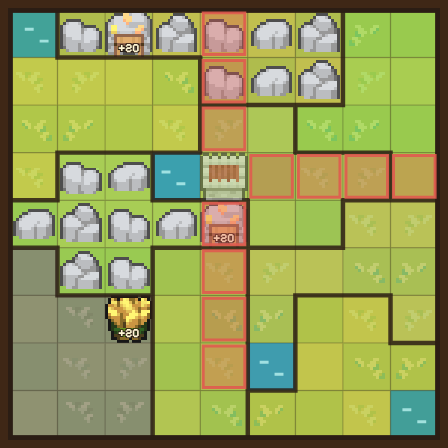
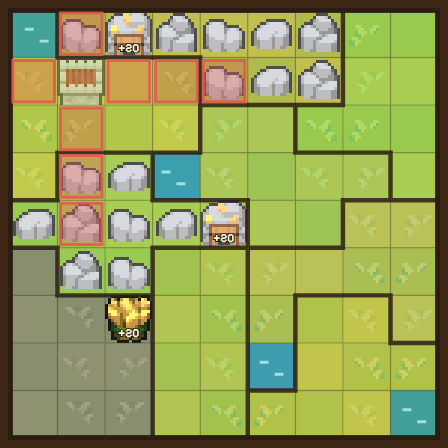
Growing: farmers at the edge
Farmers are free, but every farmer blocks the eight cells around it. Put them where their ring covers cells you would never use anyway – along land borders, next to lakes, against the board edge – and keep the open pasture inside a land for the next pieces.
Knights pay for themselves
A knight costs 10 and earns double: 5 × 2 on pasture, 7 × 2 in a land with a lake, 20 × 2 on a treasure. On lake pasture a knight is in profit the moment it lands; on a treasure it nets 20 × 2 − 10. Under Costly knights (20) only treasures and lake pasture are worth it; under In the king's pay (5) knights are your best piece almost everywhere.
Bishops open doors
Use a bishop when a land you want is not connected to your domain yet: its diagonals cross borders, and from its claim farmers can start in the new land. It is also the cheapest way into the moor for herbs.
Treasures first
Before every move, look at which cells the new claim would cover. A claimed treasure is lost. Take treasures before you claim around them – and under Mining partnership, plan the second piece in that land before you start.
Laws at a glance
| Law | Play it like this |
|---|---|
| Mining partnership | Treasures need two pieces in their land – start lands with a treasure as pairs. |
| One farm per land | Farmers become precious; knights and bishops fill the lands. |
| Costly knights | Farmers first, knights only for treasures and lake pasture. |
| Costly bishops | Reach new lands with the castle's lines instead. |
| In the king's pay | Knights everywhere – they earn double for little. |
The land star
Half of a land is enough. Count before you place: a farmer that brings a land from 4 of 9 to 5 of 9 is worth a whole land; a farmer deep inside a land you already rule only adds gold. In the last moves, check every land that is one cell short.
The endgame
Gold counts at the end. A knight or bishop placed in your last moves costs gold that may not come back – and can lose the gold star. The game warns you when a move would end the game; use the moves you have left on free farmers where they still earn.
Duels
- Stack strength where you must hold. Land claimed by two of your pieces is hard to take.
- Contested is not lost. Tying a land the opponent rules takes it away from them without you ruling it – often the cheapest way to swing the count.
- The second move belongs to player B. In the snake opening B moves twice right after the castles – plan both moves together.
- Don't run out of moves while behind. If you are stuck and trailing, the game ends immediately.