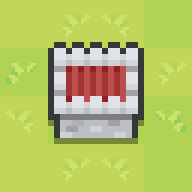
 Ninelands
The four pieces
Every piece has a reach (how far it claims), a shape (straight lines, diagonals or a ring), and a rule for where it may stand. In duels it also has a strength.
| Piece | Cost | Claims | Reach | Crosses land borders | Strength | |
|---|---|---|---|---|---|---|
 |
Castle | 0 | straight lines | 5 | yes | 3 |
 |
Knight | 10 | straight lines | 2 | no | 2 |
 |
Farmer | 0 | the 8 cells around it | 1 | no | 1 |
 |
Bishop | 15 | diagonals | 2 | yes | 1 |
Reach is a budget per direction: pasture costs 1, mountains and moor cost 2, a lake ends the line.
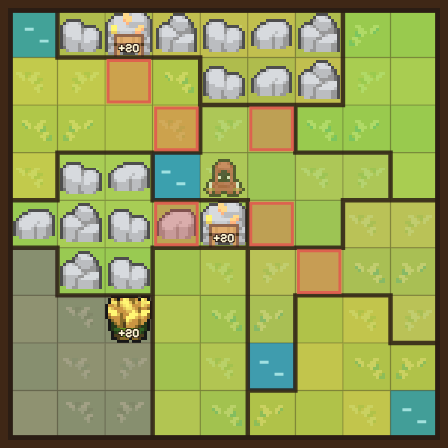
Castle
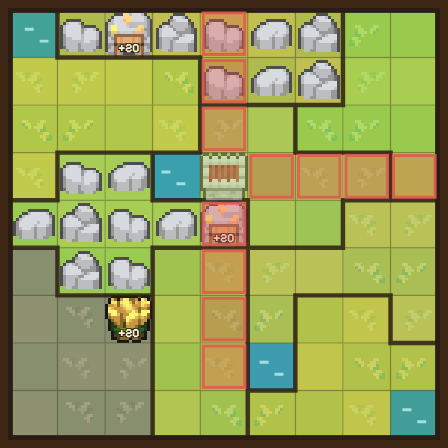
Free, one per game, always your first piece. Not in the moor. It is the only piece that needs no connection – it founds your domain. Its long lines reach into neighbouring lands and decide where the rest of your realm can grow.
Farmer
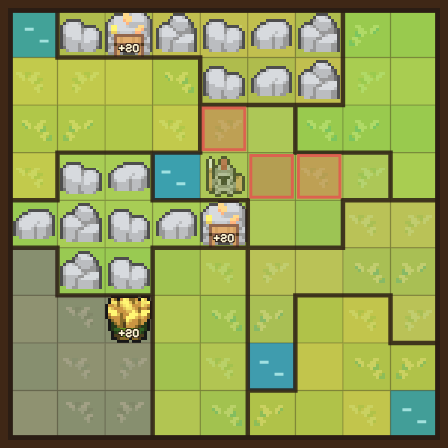
Free and plentiful – your main source of steady gold. A farmer must stand directly next to your domain, in the same land, and claims only the ring around it inside that land. Not in the moor.
Knight
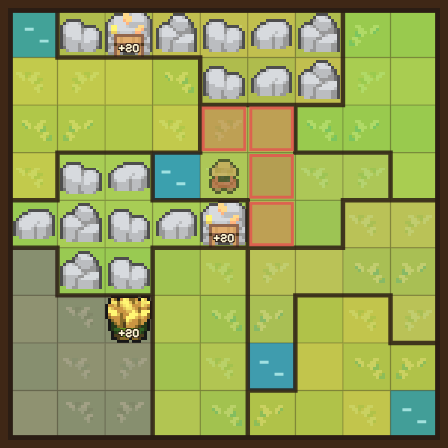
Costs 10 gold and earns double: 5 becomes 5 × 2 on pasture, a treasure pays twice. A knight stays in its land: its claim never crosses a border, and it must connect to your domain inside that land. In duels it is your strongest attacker after the castle.
Bishop
Costs 15 gold. The bishop claims diagonals and crosses borders; its claim only has to touch your domain somewhere. That makes it the piece for jumping into a new land or reaching a far-away treasure. It may stand in the moor, where castle and farmers can't.